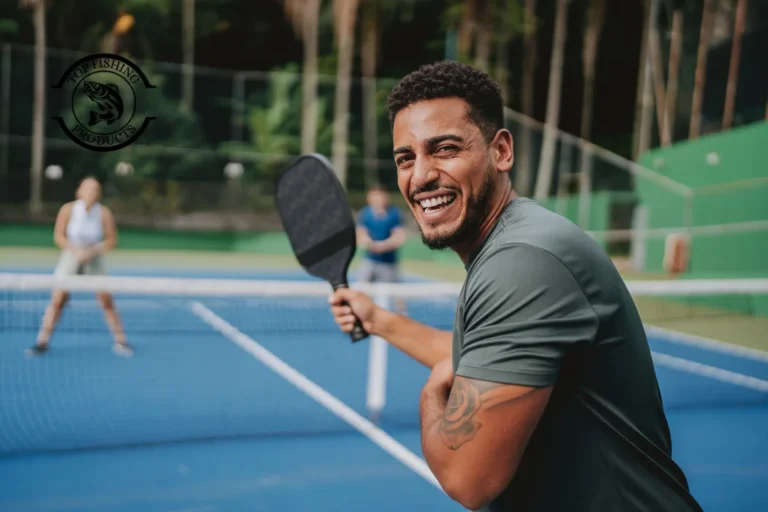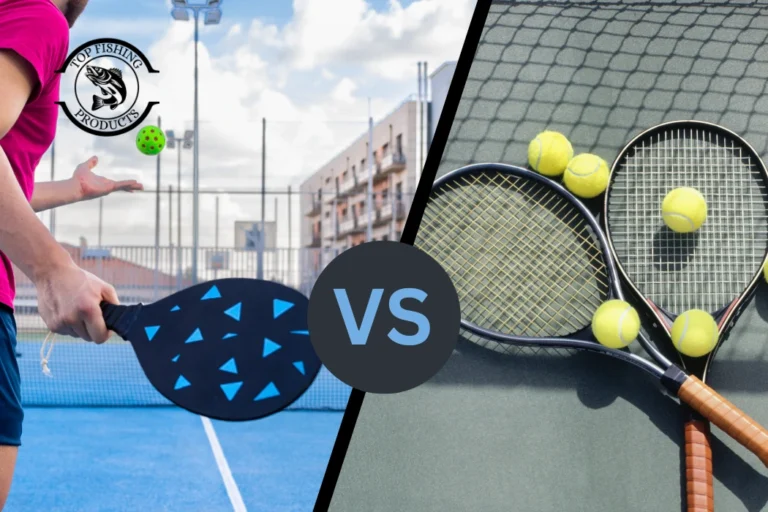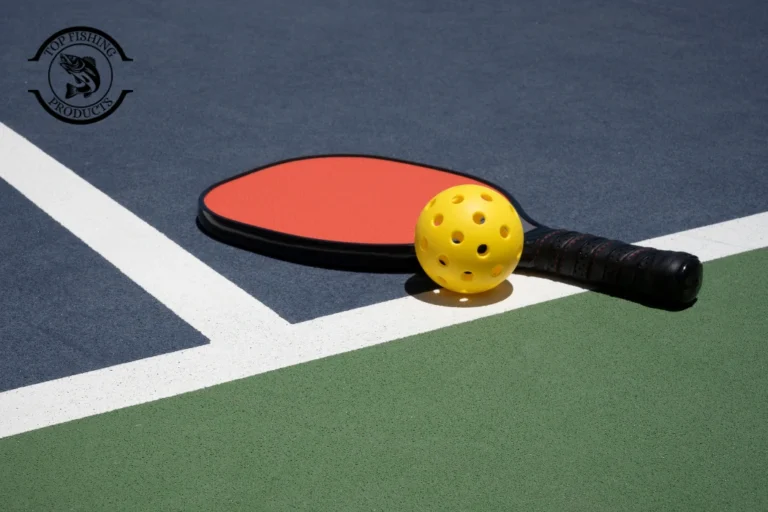

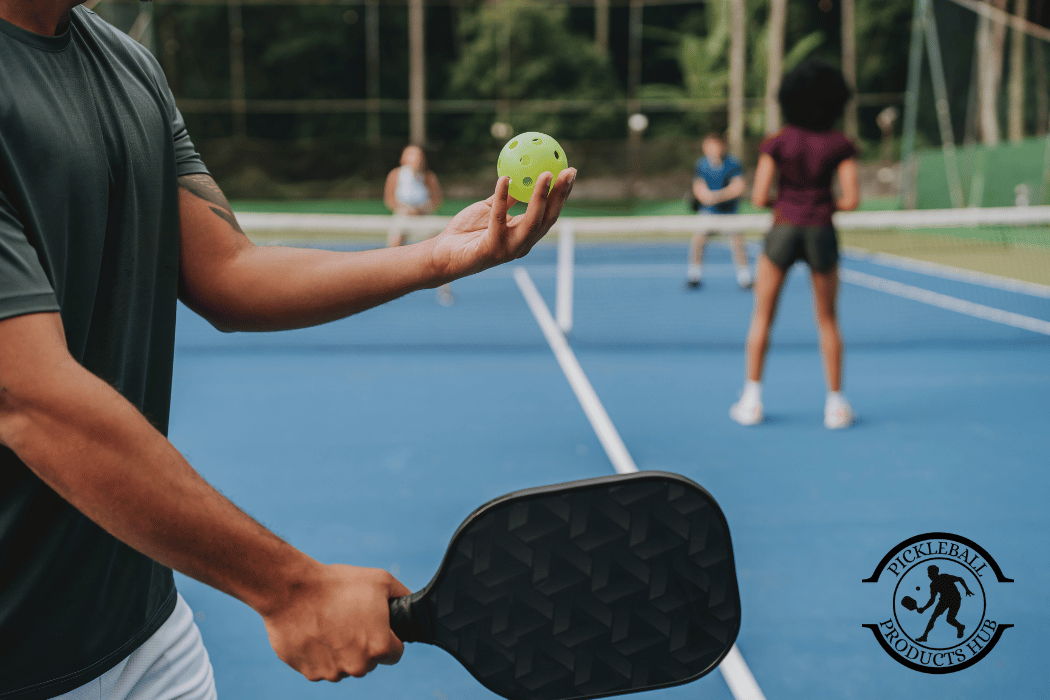
A volley in pickleball is when a player hits the ball in the air before it bounces on the court. This kind of shot requires quick control and response time and is usually made close to the net. Volleys happen fast, giving the player less time to respond than groundstrokes, which are made after the ball has had a chance to bounce.
An important part of pickleball, volleys can be used to control rallies and put pressure on the opposition. Players at the net usually use volleys to force mistakes and keep the ball low. A beginner can avoid mistakes and build confidence at the net by understanding what a volley is. Placement, balance, and soft hands are more important for a successful volley than a lot of power. Let’s explore it:
Why Volleys Are Important in Pickleball
Pickleball depends highly on net play, volleys are an important part of the game. Fast volleys are used to win points in the non-volley zone, where points are scored or lost. Players can stay active without giving their opponents an easy chance to score when they volley at the right time. Maintaining court position also depends on volleys, especially when both teams are positioned near the kitchen line.
Players with poor volley abilities often have to react too quickly, which causes them to lose control of the ball. Learning volley skills will improve a beginner’s touch and ability to respond. Advanced players will use volleys to make winning angles, stop hard strokes, and carry on rallies.
Difference Between a Volley and a Groundstroke
In pickleball, the ball’s bounce is the main difference between a volley and a groundstroke. A groundstroke is a shot taken after the ball has bounced, whereas a volley is a shot made before the ball has a chance to bounce on the ground. Groundstrokes allow the player more time to respond and are usually made from the baseline or mid-court.
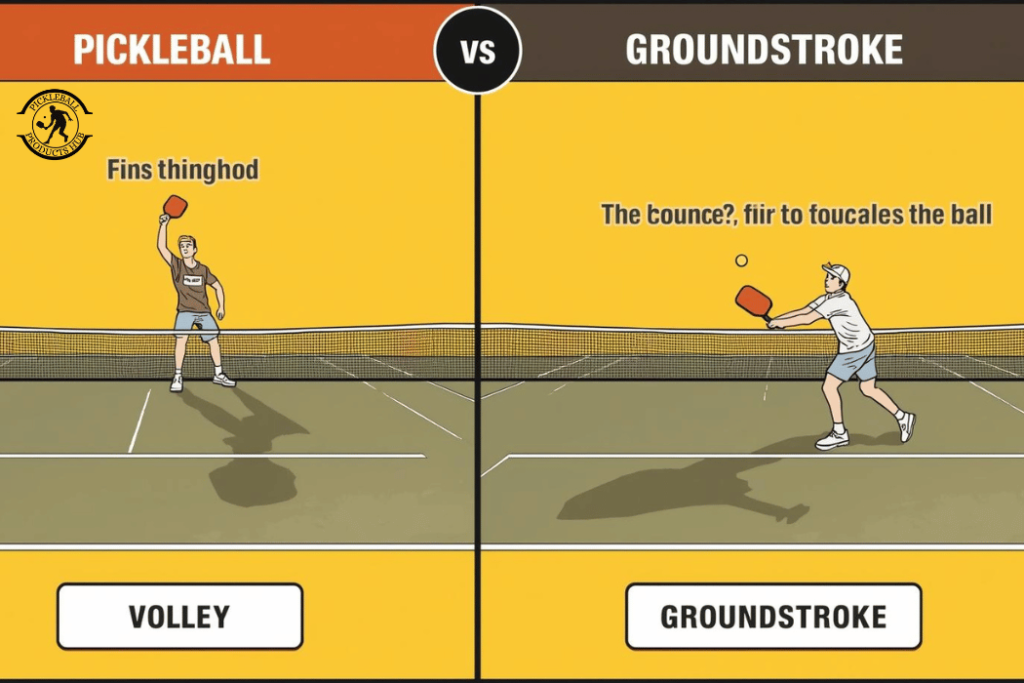
Volleys are made quickly and call for fast reflexes. Volleys are short, quick motions, whereas groundstrokes are more complex swings. For new players who may have a desire to make strong volley swings, this is a common source of confusion.
Where Volleys Are Usually Played on the Court
Volleys are often played near the net, especially in the area of the non-volley zone line. Here, players move quickly and try to control the rally. Net volleys are the most important in pickleball, even if volleys can be made from different spots on the court. Players can steal time from their opponents by making volleys near the net.
However, timing is important since a fault occurs when you enter the non-volley zone while volleying. Players can stay balanced and in line when they have good court awareness. Reaction time is improved by knowing the proper position to follow when volleying.
Understanding the Non-Volley Zone Rule
An important pickleball rule related to volleys is the non-volley zone, sometimes referred to as the kitchen. Standing in the non-volley zone prevents you from volleying the ball. The purpose of this rule is to prevent players from hitting the ball while they are standing at the net. When a player attempts a volley, it is considered a mistake if their foot hits the kitchen line or the zone inside the kitchen.
A player entering the kitchen after a volley is still considered a fault since even movement will be counted as a fault. Since most mistakes are caused by a lack of foot control when trying volleys, it is important for new players to understand this rule.
Legal Volleys in Pickleball
All pickleball rules about timing and foot placement are covered in the proper volley. Before the ball has an opportunity to bounce, the player must make contact with it and be completely outside of the non-volley zone. In addition, the paddle must make clean contact with the ball, avoiding carry or double hits. In order to keep the ball low, legal volleys are usually gentle and well-controlled.
The majority of new players think that a forceful volley is acceptable, but it’s actually controlled. To improve their accuracy and confidence, players might practice making legal volleys. Players will feel more comfortable playing aggressively if they are aware of the regulations about acceptable volleys.
Illegal Volleys and Common Faults
A lack of balance or incorrect foot placement might result in illegal volleys. Moving into the non-volley zone when volleying the ball is the most common form of illegal volley. Another common mistake is when a player makes contact, loses their balance, and falls into the kitchen.
In addition, some players make contact with the ball a bit too late, which can result in a carry or double hit. This happens often when players rush their shots during a fast rally. Beginners should practice positioning and take their time. Players might enhance their placement by analyzing situations of illegal volley.
How to Perform a Proper Volley
In pickleball, a good prepared position is the first step towards a successful volley. With the eyes on the ball and the legs slightly bent, the paddle must be held in front of the body. The paddle must be swung using little arm effort in a brief, controlled stroke.
Instead of swiping at the ball, most volleys involve stopping it. Maintaining a steady paddle face helps in moving the ball in the right direction. Good footwork and sensitive hands are necessary for a successful volley. A lot of beginners make mistakes by overswinging the paddle.
In pickleball, different situations require different types of volleys. Each volley helps with control, defense, or creating scoring chances at the net. The main types of volleys in pickleball are given below:
1. Block Volley
One of the most common volley types in pickleball, especially during quick net exchanges, is the block volley. When a player faces a hard shot from their opponent, they use this kind of volley for defensive purposes. Instead of making contact with the ball, the player simply blocks it with the front of the paddle.
This shot helps to slow down the speed of the ball and return it gently over the net. To keep the ball low and avoid attacks, block volleys are especially helpful. Soft hands and paddle control are necessary for this kind of volley.
2. Punch Volley
When there is an opportunity to use pressure on the opponent, a more forceful type of volley, known as a punch volley. It calls for a quick, precise forward motion, similar to a punch, without using a complete swing. When the ball is high enough to be attacked but still needs to be controlled, this volley is required.
Punch volleys usually target the opponent’s feet or an open area to force a weak reply. In this shot, timing and placement are more important than power. The punch volley is a great way to complete a point or force the opposition to defend without making a mistake.
3. Soft Volley
The goal of the soft volley is to maintain control at the net and control the pace of the match. Very little force is needed for the soft volley. When a player wants to restart the point or in a dink, they typically use the soft volley. To simply get the ball over the net, the paddle’s angle is slightly open.
The ball is kept low by the soft volley, making it extremely difficult for the opposing team to attack. Because it builds patience, the gentle volley is highly beneficial for new players. For beginner players, the gentle volley is important because it builds patience.
4. Defensive Volley
Defensive volley is used when a player is under pressure and needs to continue the rally. The focus of a defensive volley is on survival instead of attack. Returning the ball safely and giving you time to recover are the goals of a defensive volley. When dealing with fast-moving balls or unexpected attacks at the net, a defensive volley is sometimes used.
To slow down the ball, a defensive volley usually uses a paddle face and a relaxed grip. A defensive volley aims for consistency rather than winners. In high-stress rallies, especially against aggressive opponents, players can maintain control and avoid panic by mastering defensive volleys.
5. Drop Volley
A drop volley is a soft touch that drops softly in the opponent’s kitchen after being hit close to the net and just making it over. When opponents are playing deeper or expecting a faster return, a drop volley can be quite effective. Drop volleys are extremely difficult to control since the opponent can easily attack if the touch is too forceful.
A drop volley can be used to change the rally’s flow and force the opposition to advance quickly. Drop volleys are challenging for beginners to perform, but once learned, they may be quite effective.
6. Angle Volley
The angle volley is used to move the opponent into an incorrect position by hitting the ball strongly in the direction of the sidelines. The angle volley favors placement over force. When opponents are grouped or focused in the middle of the court, the angle volley works well. The ball may go wide due to a small change in the paddle’s angle, creating an open court.
One kind of volley that requires excellent control and court expertise is the angle volley. Rather than ending a point, angle volleys are typically used to set up a winning shot. At the net, angle volleys can improve placement and strategic thinking.
7. Reaction Volley
A reaction volley takes place when a player has very little time to react. Volleys that depend on instinct and reaction time are known as reaction volleys. In quick play exchanges at the kitchen line, reaction volleys are often seen. The player responds to the ball’s direction while keeping their paddle up.
There is only a fast block or reaction, no swing. Reaction volleys highlight the importance of being focused and in a ready position. Although they are more challenging to control, practicing reaction volleys can improve hand speed and reaction time. Advanced net play naturally includes reaction volleys.
Common Mistakes Beginners Make with Volleys
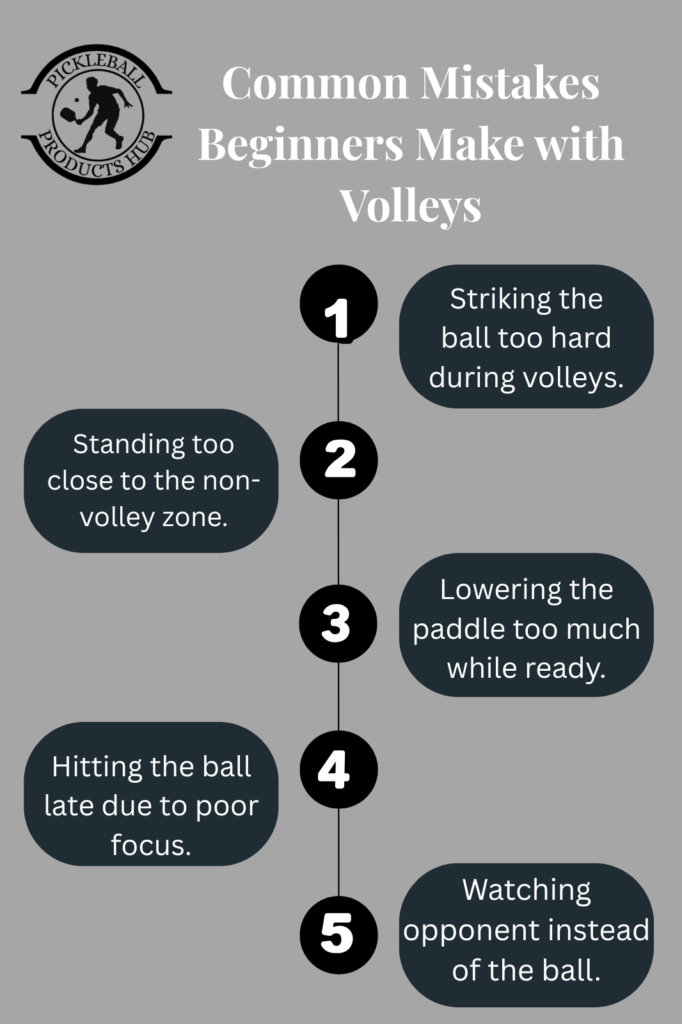
Volley shots can be challenging for beginners because they often strike the ball too hard. Hitting the ball hard is not the goal of volley shots. Standing incorrectly close to the non-volley zone boundary is another mistake that people make. This leads to mistakes. Additionally, players often lower their paddle too much.
Which affects their ability to respond to the ball. In addition, some players hit the ball late because they often look at their opponent instead of the ball. These are common mistakes that can be fixed. Understanding these mistakes early allows players to improve faster and feel more confident during games.
When to Use a Volley Instead of Letting the Ball Bounce
In pickleball, knowing when to volley is important. Volleys work best when the ball is high enough to be controlled, and staying at the net is beneficial. It could be preferable to let the ball bounce when it is low or difficult to control.
Beginners frequently make mistakes by volleying balls that are allowed to bounce. Making the correct choice requires the ability to read the ball’s height and speed. Just as important as knowing how to volley is knowing when not to.
Volleys in Singles vs Doubles Pickleball
There are different uses for volleys in pickleball singles and doubles. Volleys are more common in doubles pickleball because both teams spend more time at the net. Volleys are still important at the net, but they happen fewer times in singles pickleball because players are covering more ground.
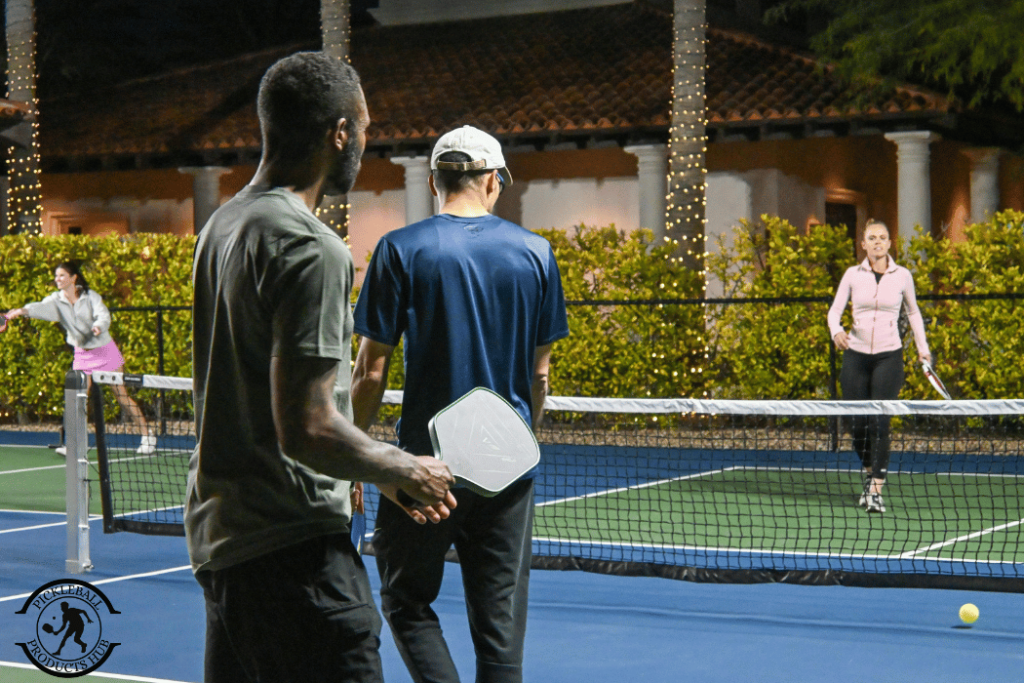
Because there is more court to aim at, singles volleys might need more accuracy. Players may change their strategy by being aware of these variations. Strong volleying abilities can assist players in managing the game effectively, completing points in both singles and doubles.
How Volleys Help Control the Game
Players can control the pace of play with volleys. A well-timed volley limits the opponent’s options and puts pressure on the defense. A soft volley allows the player to take control of the following stroke by forcing the opponent to hit the ball in the air.
The player might reestablish balance in the rally with a defensive volley. The ability to control the ball’s direction and the speed at which the rally progresses is possessed by players who are skilled at volleying. In volleying, control is more important than power.
Practicing Volleys for Better Consistency
It takes practice to increase volley consistency. Players need to work on maintaining the paddle in front of them and maintaining a stable, ready position. Players can improve their touch and control by practicing a soft volley. Players’ muscle memory and reaction time both increase with practice.
Players must practice volleys at slower rates before raising the speed in order to increase volley consistency. To boost confidence, players might practice volleys with a wall or a partner. Players have less anxiety during real games when they practice volley regularity. Over time, players learn to stay calm and controlled during fast net exchanges, which leads to better results and fewer mistakes.
Mental Approach to Volleying in Pickleball
The emotional part of volleying is often ignored. Making effective volleys requires maintaining control during a fast exchange of shots. Quick decisions and bad judgment are the results of losing your sense of control. Knowing the rules and having faith in your abilities are the basis of confidence.
Instead of making quick decisions, players must maintain focus on the ball and defend against shots. Particularly during a long dink and volley rally, players need to exercise patience. A good mental game enables athletes to remain calm under pressure. Players’ volleys become more accurate when they maintain control.
How Volleys Fit into Overall Pickleball Strategy
Volleys are an important part of pickleball strategy, especially for advanced players. Teams can maintain control of the net and rallies by using volleys. Players with strong volleying abilities can switch from defense to attack easily. The majority of successful rallies start with strong volleys resulting in poor returns.
Knowing when to restart with gentle volleys and when to go for the kill are key components of strategy. Players who understand the full scope of volleys play better and make fewer mistakes. Improving volley abilities improves the strategy of the game as a whole.
Conclusion
In pickleball, a volley involves much more than just hitting the ball. It’s a skill that calls for balance, control, and knowledge of the regulations. The rallies are decided by people. Beginners in pickleball will pick things up more quickly and make fewer mistakes if they understand how to position themselves and volley appropriately.
Pickleball players will play more intelligently if they know when to volley and when to let the ball bounce. With practice and the correct mindset, volleyball is a skill that can be developed. Pickleball players who are skilled in volleys will be able to manage the net, develop confidence, and perform at a better level.
FAQs
1. Can you volley the ball inside the kitchen?
No, you cannot volley the ball while standing inside the non-volley zone. Doing so results in a fault, even if only one foot touches the line.
2. Is power important when hitting a volley?
No, control and placement are more important than power. Soft and controlled volleys are more effective and safer.
3. What is the most common volley mistake for beginners?
Stepping into the non-volley zone while volleying is the most common mistake beginners make.
4. Can a volley be used for defense?
Yes, defensive volleys are often used to block fast shots and keep the rally going.
5. Are volleys used more in singles or doubles?
Volleys are used more often in doubles because players spend more time playing at the net.