In pickleball, a player makes a fault in pickleball when they break a rule during a game, which ends the point. The other team may lose a serve or a point as a result of a mistake. Mistakes are an important part of pickleball, especially for beginning players, but it is important to understand what a fault is in pickleball to perform better in a game. While pickleball seems like a simple game, there are a few rules that must always be followed.
Players often lose points because they made mistakes instead of because their opponent made a strong shot. To be calm and enjoy pickleball more, players must know what is considered a fault. As players gain experience, fault awareness becomes a key part of smart and controlled gameplay. Let’s explore it:
Why Understanding Faults is Important in Pickleball
Faults have a direct effect on score and progress in pickleball. Even if the player was in a good position, a single mistake may end a rally instantly. Faults are more likely to decide the result of a close game than smart shot placement. Knowledge of faults enables players to play smarter, not harder.

Players focus on accurate placement, timing, and position rather than attempting to finish a point quickly. This method results in fewer faults and increased consistency. In pairs, players who are aware of their weakness also communicate more efficiently.
How Faults Affect Scoring and Flow of the Game
Faults in pickleball’s rally format cause the game to end immediately. If a fault is made by the team serving, they will lose the service. In a doubles match, however, the service will first go to the partner and then to the other side.
A point will be given to the serving team if the receiving team makes a fault. As a result of this method, momentum can change extremely quickly due to mistakes. A few missteps can result in a winning position turning into a losing one.
Common Reasons Beginners Commit Faults
Beginners mostly make mistakes because they are still learning the rules and developing control. A lot of beginners are focusing too much on hitting the ball instead of swinging or on where they are standing. This explains why there are so many illegal serves, kitchen mistakes, and foot defects.
Beginners’ need to act quickly enough without considering is another major cause of their mistakes. They have a bad balance and make contact too late because of this. A lack of confidence and anxiety are also major causes of mistakes made by beginners. Let’s discuss it in detail:
1. Serving Faults in Pickleball
In pickleball, serving faults are some of the most frequent faults in pickleball. The serve must be made underhand, with the paddle head lower than the wrist and contact with the ball below the waist. An improper serve occurs if any of these conditions are not met, resulting in a fault.
Stepping on or over the baseline before making contact with the ball is another mistake that can happen during the serve. The server must also make contact with the ball and then hit it straight into the correct service box. Failure to do so, or if the ball lands outside the box or does not clear the non-volley zone, results in a fault.
2. Foot Faults During the Serve
Foot faults in serving happen when the feet are not put in the right position. Until the ball is hit, at least one foot must be behind the baseline. It will be considered a fault to make contact with the baseline or to enter the court before striking the ball.
Foot faults can occur when players are nervous or trying to strike the ball forcefully, and they can sometimes occur accidentally. Paying attention to foot placement is just as important as paying attention to the paddle while serving.
3. Non-Volley Zone Faults
The Non-Volley Zone, commonly known as the kitchen, is one of the most confusing zones in pickleball. When a player is in the Non-Volley Zone or in contact with its lines, they are not allowed to volley the ball. This is considered a defect.
A player can make a legal volley and yet commit a fault in pickleball if their forward motion carries them into the kitchen. The purpose of this rule is to prevent players from gaining an unfair advantage by attacking opponents too closely at the net.
4. Volley-Related Faults in Pickleball
A volley fault is made when a player makes contact with the ball in the air while violating a regulation. Standing in the non-volley zone when the shot is being executed is the most popular way to do this.
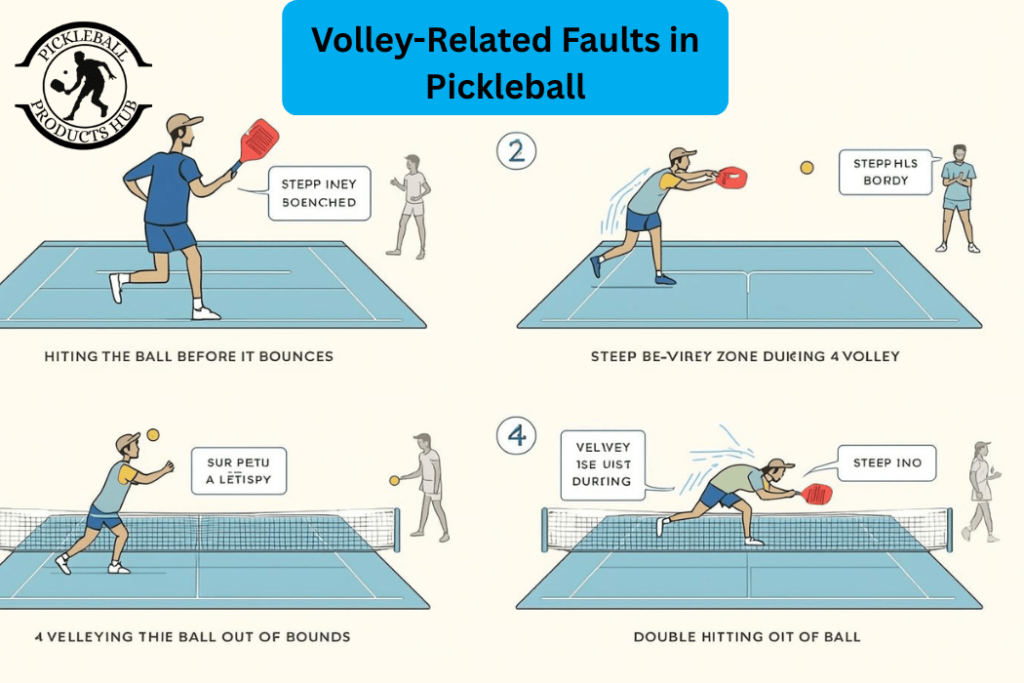
Players who make contact with the ball too late, resulting in a carry or double hit, are also guilty of volley faults. Volleys require quick reflexes and careful handling. When players try to make contact with the ball too forcefully, they often lose their balance and make mistakes.
5. Double Hit and Carry Faults
A double hit happens when the ball gets hit twice in a single effort. When the ball is kept on the paddle for an extended period of time instead of bouncing off it, it is referred to as a carry. Carrying is a mistake, even though double hits are acceptable if they occur in a single motion, and both situations are considered a fault in pickleball when they break the official rules.
Players frequently make this mistake when they hold the paddle too tightly or respond slowly to the ball. The fault can be fixed by letting go of the paddle and making clean contact with the ball. Timing is everything.
6. Out-of-Bounds Faults in Pickleball
An out-of-bounds mistake happens when the ball goes beyond the boundaries of the court. Players frequently make these mistakes when they hit the ball too hard or estimate angles incorrectly. Other reasons for this include wind, bad positioning, or panic.
A wise player will favor placement above power, ensuring that the ball stays in play and providing the opposition team time to make errors. Reducing out-of-bounds mistakes results in longer rallies, better game management, and more consistent results.
7. Net Contact Faults
A net fault happens when a player makes contact with the net during a game, using possibly the paddle, their body, or clothing. Net mistakes are especially common in aggressive shots or when players are engaging in a close game at the net.
Players need to be aware of their distance, balance, and control to prevent net mistakes. Players who are patient and careful of their movements will stay clear of mistakes and unnecessary contact.
8. Faults Caused by Player Interference
Player interference occurs when a player unfairly distracts or interferes with their opponent. Crossing into the opponent’s court, blocking shots, or intentionally causing distractions that result in a mistake are examples of player interference.
Pickleball is a game that encourages fair play and sportsmanship. It is important to respect the opponent’s court as a result. This ensures that the game is played in a favorable atmosphere for all teams.
9. Faults in Singles Pickleball
In singles pickleball, faults can easily occur due to stress and the need to cover the whole court. In an effort to reach open areas, players frequently rush their shots, make foot mistakes, or smash the ball out of bounds. Reducing faults requires a combination of control and confidence.
To guarantee consistency, players can efficiently control their shots. Reducing faults improves players’ performance in singles pickleball, where accuracy and patience are more important than strength.
10. Faults in Doubles Pickleball
Mistakes related to coordination and communication are common in doubles pickleball. Faults in pickleball such as shot errors, poor positioning, or kitchen violations often result from weak communication between players. The fact that both players are close to the net shows that there is a strong need to collaborate and stay aware in order to avoid errors and unnecessary faults.
Mistakes can be avoided by communicating and being aware of each other’s moves. Players can prevent errors and play successfully by understanding placement and cooperating as a team.
11. Mental Impact of Making Faults
Faults may affect a player’s level of confidence, especially for new players. Faults can cause frustration, quick reactions, and a lack of concentration, all of which can lead to more mistakes in an endless process.
Experienced players see mistakes as an opportunity for progress rather than defeats. After a mistake, it can be avoided by maintaining calm and refocusing. The development of mental control is important in preventing mistakes from arising in a competitive atmosphere. Players with mental control consistently play well under pressure.
Role of Strategy in Avoiding Faults
While it allows players to make the best choices, a clever move usually results in fewer mistakes. Players who understand when to let the ball bounce, when to volley, and where to position themselves prevent quick mistakes.
Because they are patient, smart players force their opponents to make mistakes. Reduced mistakes are a sign of maturity and game experience. Simple rallies can be transformed into winning ones by players who understand the rules and play strategically.
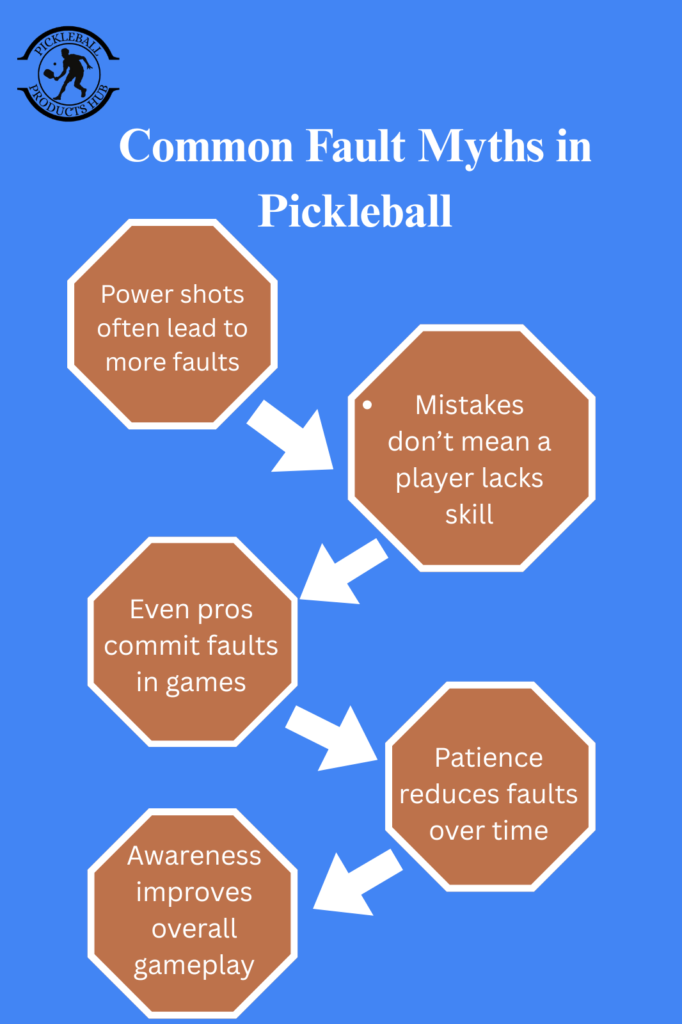
Common Fault Myths in Pickleball
Many players are under the wrong impression that hitting the ball with strength will always result in winning the game, yet this technique can result in faults. The second most common misunderstanding is that players who make mistakes are not skilful.
However, even skilled players frequently make mistakes. Players can stay motivated and avoid frustration by realizing that mistakes are a necessary part of learning. Reducing faults is a time-consuming process.
Why Kitchen Faults Are So Common
Kitchen faults are frequent because net play happens very quickly. Players frequently get excited and attack the net without thinking about where their feet are, leading to faults in pickleball. Even experienced players might quickly lose their balance and accidentally enter the kitchen during close ball exchanges, resulting in unnecessary mistakes.
Young players tend to concentrate entirely on the ball and overlook their feet. By being aware of their feet and practicing careful motions around the net, players may avoid cooking faults. Players will be able to balance and stay clear of cooking mistakes easily as they gain expertise.
How to Reduce Faults Through Practice
Players need to be aware of the regulations and practice frequently to reduce mistakes. Players can practice serving, volleying, and moving around the court at a slow and regulated speed before progressively increasing the speed.
To build muscle memory, players can practice making accurate shots and using the appropriate strategies. Players can form the habit of making clean and legal shots when they practice with intention. Players’ mistakes in real games will be reduced as a result.
How Officials and Referees Call Faults
The referees in an organized pickleball match are responsible for monitoring faults in pickleball and enforcing strict rules on line calls, kitchen violations, and serving errors. In informal games, players are expected to honestly call their own faults to maintain fair play.
Which is an excellent way to improve sportsmanship. Understanding how pickleball faults are called is important for preventing needless differences between players and ensuring that the game proceeds smoothly.
How Fault Awareness Improves Overall Skill
Players who are aware of their mistakes will learn faster since they will be playing with confidence and according to the rules of the game, as opposed to those who are hesitant or rushing their shots.
During rallies, being aware of faults in pickleball improves footwork, shot selection, and focus. Better performance on the court will naturally follow from this awareness. The longer the rallies are, the more enjoyable the game becomes, and this happens when mistakes and faults are minimized.
Long-Term Benefits of Reducing Faults
In pickleball, making fewer mistakes is more valuable than power, players who make fewer mistakes are likely to win more games. Players are in charge of the game and putting pressure on their opponents when they make fewer mistakes.
Making fewer errors also suggests that players are less stressed, and the game becomes pleasurable. Improvement in pickleball involves patience, practice, and knowledge of the laws of the game, which offer a basis for expertise.
The Final Verdict
In pickleball, a fault is any action that breaks the rules of play and causes the game to be stopped. Even if mistakes are frequently made, especially by beginner players, it’s important to understand them if one wishes to get better.
Points are lost most of the time because of mistakes and not because of the opponent’s ability to play. Learning the laws of the game, practicing footwork, and being psychologically tough will all be helpful in cutting down on mistakes.
FAQs
1. What is the most common fault in pickleball?
Stepping into the non-volley zone, also known as the kitchen, when hitting a volley is the most common mistake.
3. Can a serve be replayed after a fault?
No, a mistake immediately ends the rally and affects the hit or score.
3. Are foot faults always called in casual play?
Players are advised to call their own foot faults honestly and without arguing when playing casual games.
4. Do faults count the same in singles and doubles?
In both singles and doubles, a fault may end the rally, but it can have various effects on strategy.
5. How long does it take to reduce faults as a beginner?
With regular practice and mastering the rules, most beginners start making fewer mistakes within a few weeks.