In recent years, pickleball has become one of the most popular games, and there is a simple explanation for this. All players, no matter their age, can enjoy this easy and engaging sport. For new players, pickleball drills for beginners play an important role in building early confidence and control. Many beginners have no issue getting the ball between their hands in a short time when they play for the first time. But after some time of playing, gamers discover something interesting.
Although the game is entertaining, progress could start to slow. Once-enjoyable shots become unreliable. As players make basic mistakes, passes and shots drop to the ground. Players often make an important decision at this point. Because they enjoy the sport, some athletes choose to continue practicing. Let’s explore it:
How Drills Help Beginners Improve Faster
Drill practice is important for athletes who want to improve their abilities. You will benefit mostly from playing games on your own, but you must practice if you want to get better. Drills will help you in practicing specific shots or situations so that your body and mind can respond to them automatically.
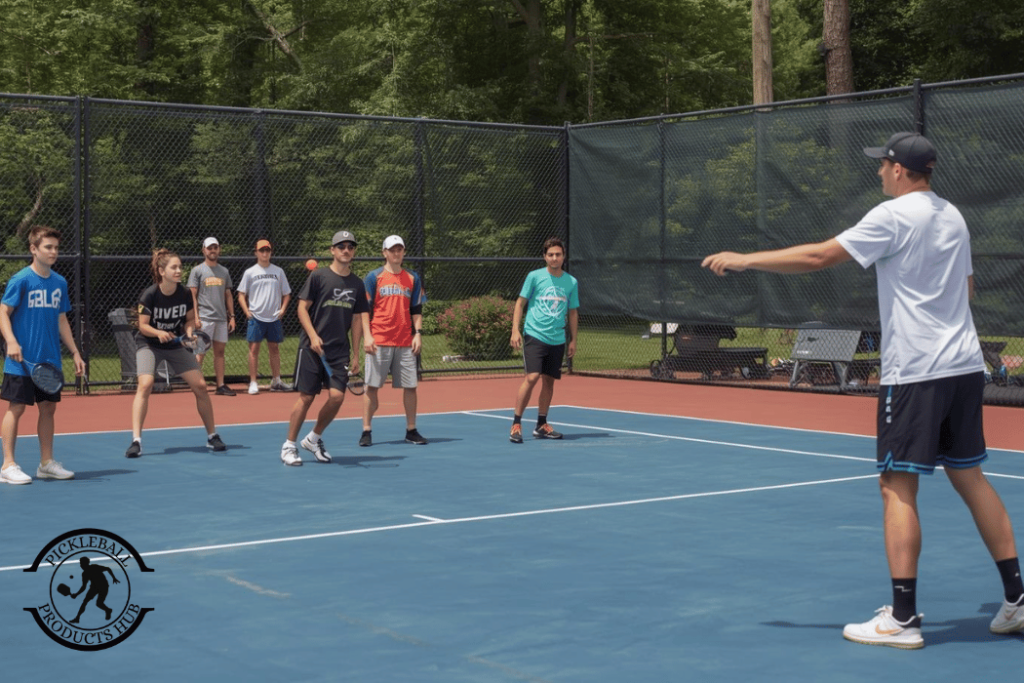
This article aims to help beginners improve their pickleball skills by offering 18 simple and efficient drills. The exercises are given in an organized way so that you understand both how and why to complete them.
Why Pickleball Drills Make You Better
Your brain creates more efficient ways to communicate with your body when you practice. Neurons are brain cells that control balance, coordination, and movement. Your brain and muscles get more connected with each practice.
First of all, learning a new pickleball skill is uncomfortable. You must consider when to swing, how to hold the paddle, and where your feet should be. But at some point, these movements come naturally to you. This explains why drill practice is so helpful. They allow you to repeatedly practice the proper movements.
In addition, drills remove pressure. You may hit shots or worry about making mistakes during a game. Mistakes are expected during drills. You can build confidence, improve your technique, and take your time. In real games, this self-assurance will be seen.
Pump Up Your Skills with Drills
Pickleball may seem simple at first, but it’s actually a fast-paced game including a number of different abilities that are used in every rally, including serving, returning, groundstrokes, dinking close to the kitchen line, and volleys, each of which has its unique style.
You can concentrate on each ability separately using drills. You divide the game into smaller parts instead of taking on the entire thing at once. Learning goes more smoothly, and you advance more quickly as a result.
Things You Should Know Before Starting the Drills on Our List
This article organizes drills into five main categories:
- Groundstrokes
- Serves and Returns
- Third Shot Drops
- Dinking
- Volleys
Control, accuracy, footwork, or timing are the main objectives of each drill. Each is explained in a step-by-step manner so you may complete it without difficulty.
It’s useful to understand three basic ideas before you begin, which are the idea of shadowing, foot movement, and how to grip the paddle. Every drill you perform has these parts.
How Do You Grip a Pickleball Paddle Correctly?
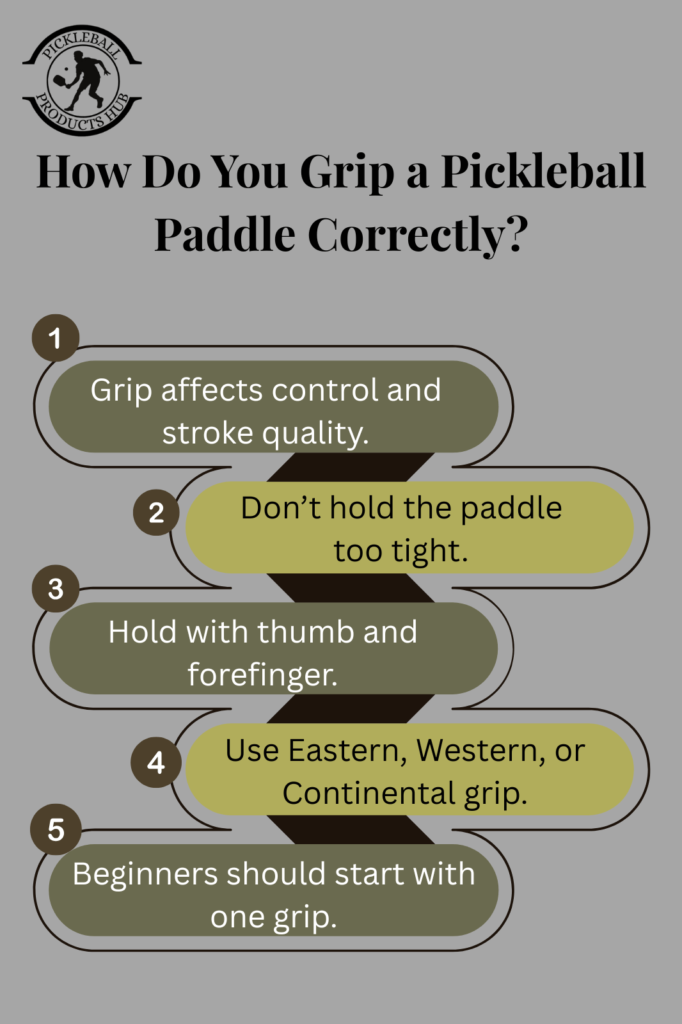
According to famous pickleball teacher Will Kerbaugh, “getting the right hold on the paddle is a crucial, no-hassle aspect of pickleball, and it alters the whole playing experience.” Will says, “Control, the quality of the strokes, and the overall feel of the shots are all greatly impacted by the grip.”
Will continues, “The idea is definitely not to grip the paddle hard.” In reality, a firm grip usually results in more throwing mistakes. In addition, a tight grip would result in a harder, firmer shot, which is usually not desirable. To maintain balance with the paddle, players should hold it with their thumb and forefinger.
The three grips are essentially Eastern, Western, and Continental. Each one is designed for a certain shot and adds a small spin to the paddle’s face. Beginners don’t need to study all three at once. They can start with one and modify it as they gain knowledge.
Footwork and Body Position
1. Footwork
You can stay balanced and reach the ball sooner if you have good foot movement. Learn foot motions that let you keep the ball in front of you at all times instead of reaching for shots or leaning. Quick, short steps are more effective than long, relaxing ones.
2. Body Position
Your body must always be prepared and in a balanced position. You can react more quickly if you place the paddle in front of you and hold it high. Agility can be enhanced by standing on the balls of your feet and bending your knees.
What is a Shadow Drill?
One shadow drill is to perform the exercise without striking a ball. You see the ball being there and concentrate only on your body’s movements from beginning to end, including the position, grip, swing path, balance, and follow-through, instead of worrying about the result of the shot.
The pressure is greatly reduced by these drills. There are fewer distractions, no hurry, and no risk of missing because there is no ball in play. Because they may learn correct techniques before any negative habits start to form, beginners will benefit the most.
However, even more seasoned players may use it to slow down the game, reset strategies, or fix problems that come up while playing. Overall levels can be raised by following for even a short while before a session.
Groundstrokes
The shots you make after the ball bounces back on your side of the court are known as groundstrokes. Pickleball sets are built on these shots. As a rally progresses, having solid groundstrokes will help you extend your recoveries, control the ball’s path, and offer greater options. Your strong side will be used in the forehand ground stroke. Your non-dominant side will be used in the backhand ground stroke.
1. Shadow Swings: Mechanics
The main goal of this exercise is to improve your swing without the ball. You can concentrate on your body rotation, weight transfer, paddle direction, and balance because there isn’t a ball in the way. Your paddle should move smoothly, and you should feel your body moving in time with your shoulders and hips.
Find a space that is open so you may practice your backhand and forehand swings at a reasonable pace. You must start slowly and increase your speed as you get skilled with the game’s rules and controls. As you practice the game, be aware of your posture by focusing on your foot position.
2. Drop and Hit: Consistency and Timing
You can improve your timing and learn the exact spot to make contact with the ball by dropping it and hitting it after one bounce, a fundamental exercise in Pickleball Drills for Beginners. This drill also teaches proper follow-through and the right moment to start your swing. To build consistent timing, practice these techniques on both your forehand and backhand.
3. Figure Eight: Footwork and Coordination
This exercise balances controlled hitting with flexibility. You are making a soft hand with the ground as your feet move in a figure-eight manner. The secret to this exercise is to maintain your balance while moving. This will train your body to maintain control even when your feet are not fixed in place and help you coordinate your movements. Clean hits are the result of good footwork, and this exercise uses movement with suitable technique.
4. Forehand to Forehand (Backhand to Backhand): Control and Accuracy
The goal of this partner drill is to increase rally points and avoid finishing a point with a winner unnecessarily. This steady-play exercise is a key part of Pickleball Drills for Beginners, focusing on rhythm, consistency, and building self-confidence. By practicing the same shot repeatedly, you train your body to make dependable strokes. Start slowly and calmly, then gradually increase your speed as your confidence grows.
5. Cross-Court Rally: In-Bounds Control
Due to the court’s diagonal stretch, cross-court shots create more space. Your aim, stability, and shot selection will all improve with this exercise. Because you have to return to a solid position after sending a ball wide, it also teaches you how to recover quickly. These skills are immediately applicable to actual gameplay.
6. Groundstroke Down the Line: Control and Decision-Making
It takes a lot of effort and skill to hit a groundstroke straight down the line, and this technique is an important focus in Pickleball Drills for Beginners. Because there is less room for error with this shot than with cross-court shots, it requires not only perfect contact but also stable balance and smart judgment.
When it’s safe to change directions is something that players must learn. In addition to teaching when it’s appropriate to start an attack, this exercise will improve control, timing, and confidence. Rapid decision-making gets faster and more reliable with regular practice.
7. Switch Sides: Footwork and Position
Speed and court awareness are enhanced by the practice of switching sides, which aids in maintaining continuous motion following each shot. The player improves his bouncing skills by changing sides continuously, which helps condition the body to recover quickly.
Additionally, it helps the player get used to uncomfortable areas where adjustments frequently take place during real games. Over time, they develop the ability to maintain cool even in awkward situations.
1). Serves and Returns
The first actions in a rally are serving and returning, which eventually affect how many points are scored. When used in a pair, a strong serve and a deep return of service force the opponent to respond, which is an excellent strategy for gaining a favourable position and winning the point.
8. Toss and Catch: Touch and Feel
A simple yet effective exercise for developing soft hands and smart paddle control is the toss and catch, which is an important part of Pickleball Drills for Beginners. Even for new players, catching the ball with the paddle helps them understand how the paddle can absorb energy instead of striking it too hard, improving touch and feel while building confidence. This exercise forms a strong foundation for improving serves, dinks, and reset shots.
9. Serve to Target: Accuracy and Confidence
Serving to a target shifts the goal from simply hitting the ball over the net to delivering it with purpose. By encouraging players to aim deep and off the structure of their opponents, this practice improves accuracy, consistency, and confidence. A well-placed serve pinches the returner right away, and with persistent effort, a dependable serve arrives that seems like a strength instead of a weakness.
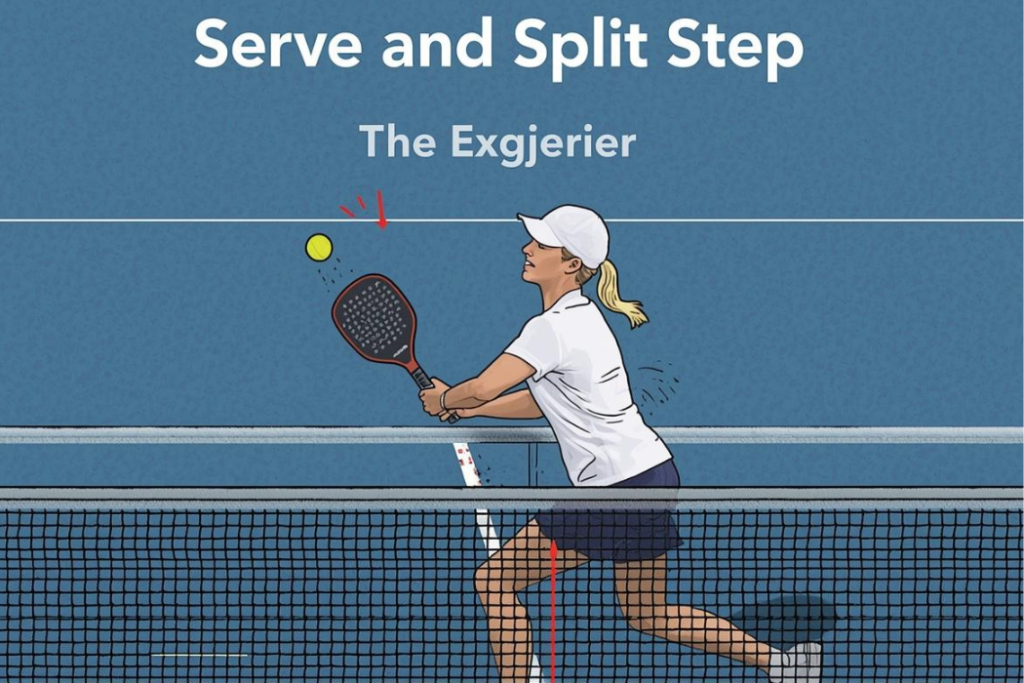
10. Serve and Split Step: Movement and Patience
The purpose of this exercise is to practice correct movement immediately following a serve. Players can maintain their balance and fitness by taking the dividing step instead of making an aggressive advance.
Court positioning is enhanced by stops, reads of the return, and controlled movement. Faster responses and better follow-up shots are guaranteed since the drill develops patience that avoids rushing early in the rally.
11. Deep Returns: Control with Power
Deep return drills concentrate on keeping the ball near the opposing player’s baseline during serve returns to restrict their offensive movements. Instead of depending on just smash shots, players learn to mix power, accuracy, and control.
Time to advance and create a position at the net is made possible by these deep returns. This technique helps the player take charge of the game early on and increases confidence.
1). Third Shot Drops
One of the most important pickleball abilities is the third-shot drop. You can comfortably advance to the NVZ line, resolve one of the most intense exchanges you will come across, and neutralize aggressive opponents who approach the line to attack with this carefully played, controlled shot.
12. Wall Drops: Soft Touch and Arc
The exact arc required for a successful third-shot drop can be tuned with wall drop drills, which are a key part of Pickleball Drills for Beginners. Practicing against a wall or a target encourages you to use controlled, soft contact instead of full force. Over time, this type of exercise increases confidence, touch, and consistency. Even more useful for practicing alone, it gives you a clear sense of how little effort is needed to make a successful drop.
13. Return and Drop: Game Awareness
In this exercise, a third ball drop is combined with a serve return, just like in a real game. It teaches the player how to change from defense to attack while adjusting for changing ball speeds and angles. Completing this series lowers mistakes in decision-making and raises awareness. It also teaches the player how to maintain control and make wise choices when playing a real game.
1). Dinking
Dinking is a skill that requires timing and flexibility, especially when you are close to the kitchen line. Accurately placing soft dinks on the court puts your opponent in awkward places, which may cause them to make mistakes and offer you a chance to control the point.
14. Dink Aim: Placement and Touch
The goal of practicing dink aim is to focus on precision instead of power, and this is an essential part of Pickleball Drills for Beginners. Touch, feel, and placement are developed by aligning the ball to specific locations just off the kitchen line. With regular practice, you can learn to place dinks in ways that force your opponents to make poor reflex returns, which will ultimately help you win more dink rallies. This training also builds muscle memory and confidence in net play.
15. Two Up, Two Back: Teamwork and Strategy
The players’ ability to communicate and work together is improved by this doubles exercise. Patience, good shot selection, and teamwork are all incorporated in the drill. Both partnering synergy and general strategy awareness will be strengthened by practices involving the net and baseline. In addition to improving their placement awareness in doubles, players will learn to trust their partners more.
1). Volleys
Volleys are quick shots made before the ball has a chance to bounce. They need precise timing and fast reflexes. Strong, well-placed volleys offer you the advantage on the net, steer into the action, and reduce your opponent’s choices while applying pressure.
16. Toss Up: Reaction and Timing
A single practice activity called the toss-up drill has been designed to increase focus and response time. Tossing the ball up and volleying it before it goes too low allows you to practice quick and controlled contact.
The practice enhances your timing, improves your focus, and boosts your confidence when you’re playing at the net. Repeatedly performing this drill improves the controlled exchanges and volley cleanliness.
17. Volley Spot: Positioning and Angles
Players can hit volleys from various locations on the court with the help of volley spot drills. The players’ flexibility will enable them to handle any situation that arises if they practice from various locations on the court. Their improved footwork, balance, and shot selection at the net position are the main benefits of this exercise.
18 Drills That Will Surely Improve Your Skills
The variety of skills you need to improve your pickleball game is covered in these exercises. You can pick the techniques you wish to work on and concentrate on those instead of trying to master them all.
Your game will reflect consistent practice, and you’ll be able to observe the results in your achievements. Above all, keep in mind that having fun is what keeps you playing, even while playing regularly improves your talents.
Final Verdict
Pickleball is a game that everyone can enjoy, but real improvement comes only through regular practice. While playing matches is fun, Pickleball Drills for Beginners allow you to slow the game down and focus on learning properly. Many players ignore specific skills that often get overlooked during casual play. Shadow drills, serving routines, dinking exercises, groundstroke practice, and volley drills all work together to help you become a confident and consistent player.
The 18 drills are covered in this guide to help beginners build improvement, control, consistency, and decision-making. Most importantly, just always remember to enjoy the process. Pickleball is a combination of fun and improvement for all players. Do learn these drills to become an extraordinary player!
FAQs
1. How often should beginners practice the pickleball drills?
The best time to practice is twice and thrice per week. Even short sessions can be helpful to build consistency and improvement. If you want to build confidence on the court, then you need to be consistent for improvement.
2. Are Shadow till’s effective even without hitting a ball?
Yes, Shadow tills are very effective, even it helps the players to focus on proper movement balance and swing mechanics. There is no need for the pressure of timing a real shot.
3. Which drills should beginners focus on first?
All the beginners must start with shadow swings, drop and hit drills, and basic serving practice. If you are looking for more information, then simple dinking drills are also helpful for strong fundamentals.
4. Can these pickleball drills be practiced alone?
Absolutely, there are many to respect that can be practiced alone, including Shadow drills, serving drills, and even wall-based exercises. Another partner drill is also helpful, but it’s not always necessary to practice.
5. How long does it take to see the improvement from drills?
Most beginners notice improvements within a few weeks of consistent practice. Especially if you learn control, confidence, and short-term consistency.